

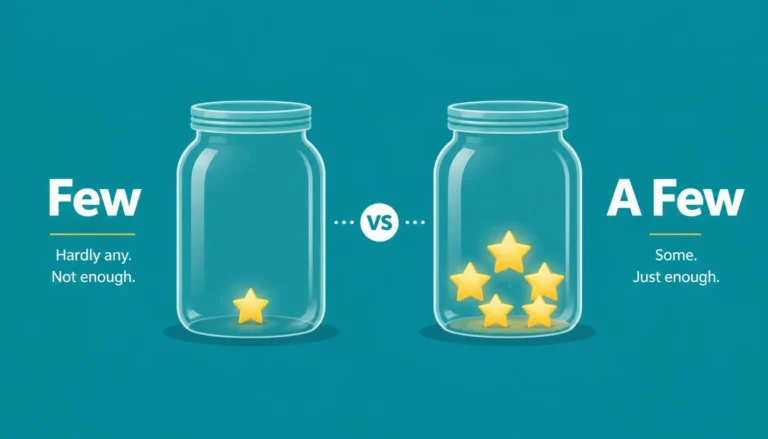
“Few” or “A Few”? The Tiny Word That Changes Your Whole Meaning
Imagine you say to a new friend: “I have few friends here.”
Now imagine you say: “I have a few friends here.”
Same words. Same number of letters. Just one small “a” is different. But your friend will understand two completely different things — and one of them sounds a lot sadder than the other.
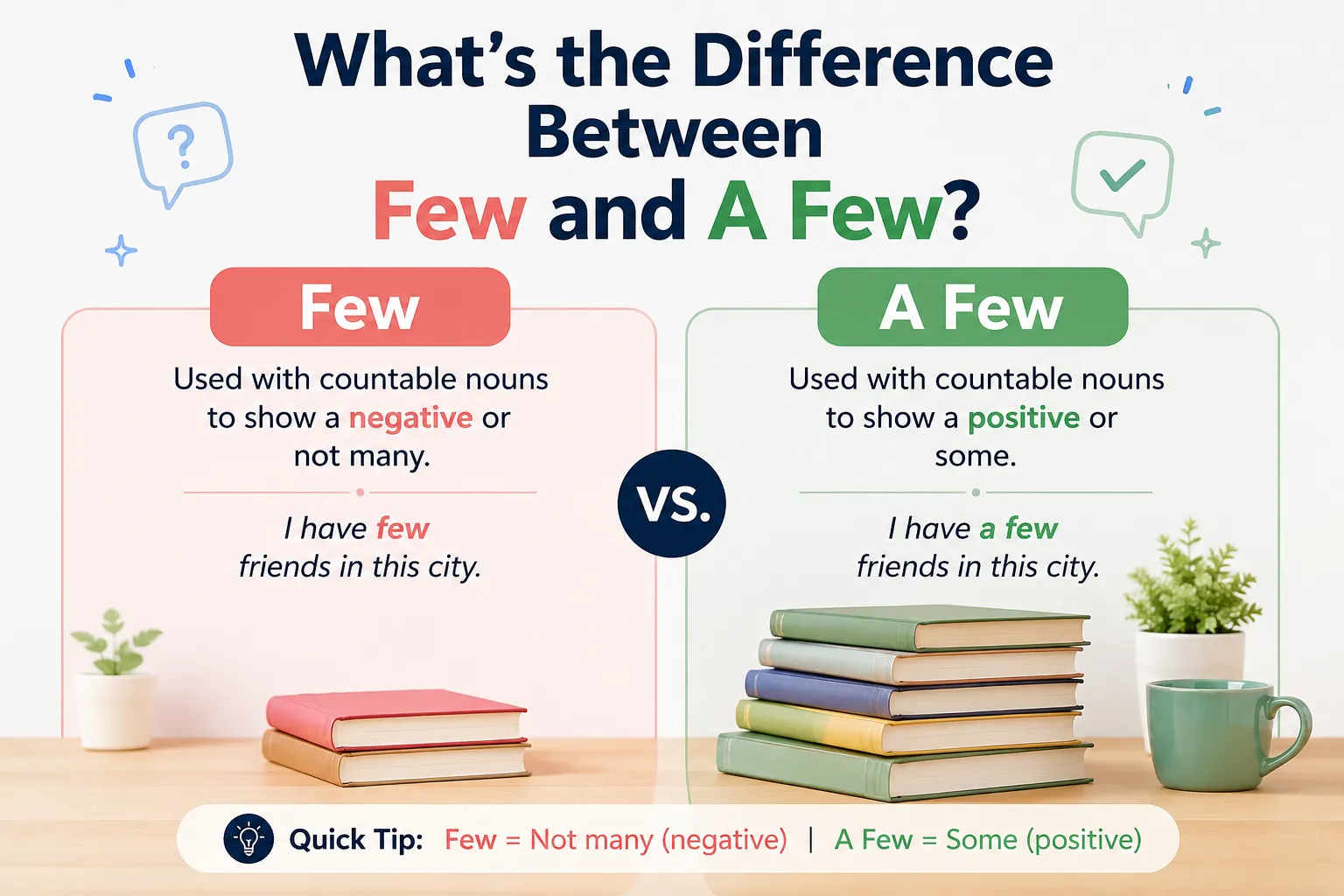
If you’ve ever paused before writing “few” or “a few” and wondered which one to use, you’re not alone. This is one of the most common questions English learners ask. In this short guide, you’ll learn the simple rule, see real examples, and never mix them up again.
The Quick Answer: What Is the Difference Between “Few” and “A Few”?
Here is the short version:
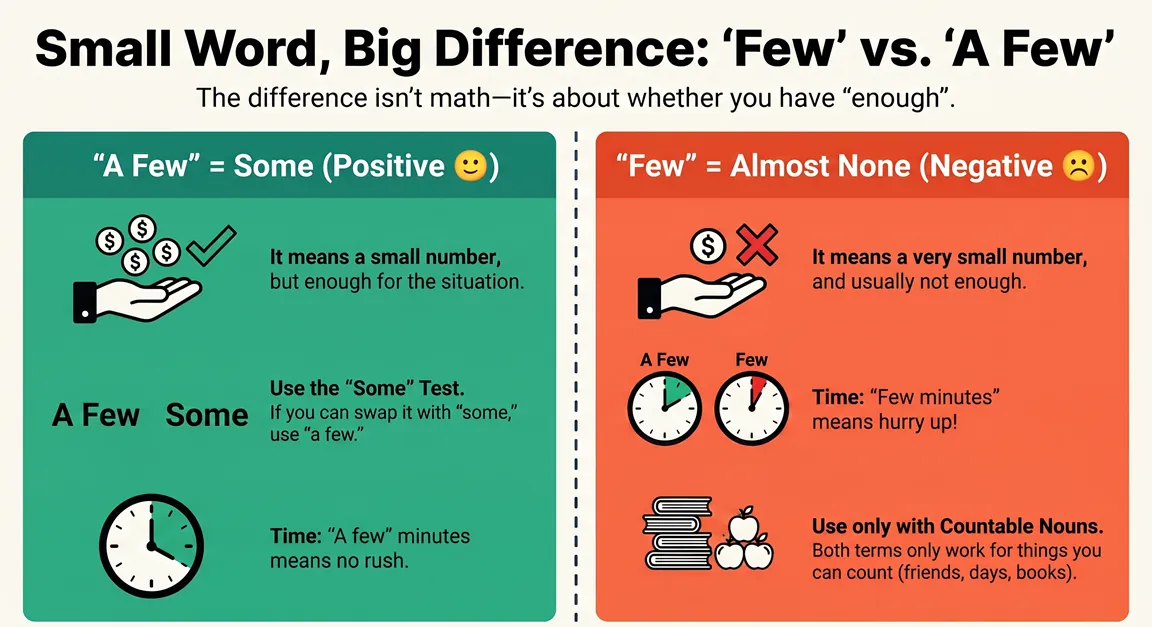
- A few = some, a small number, but enough. It sounds positive.
- Few = not many, a very small number, not enough. It sounds negative.
Both words talk about a small quantity. The difference is not really about math. It’s about feeling.
💡 Simple rule: If “a few” fits with the word “some,” use a few. If “few” fits with the word “almost none,” use few.
What Is the Rule for “Few” and “A Few”?
Both “few” and “a few” are used with countable nouns — things you can count, like friends, books, chances, or days.
| Meaning | Feeling | Example | |
|---|---|---|---|
| A few | Some, a small but okay number | Positive 🙂 | I have a few good friends. |
| Few | Very little, almost none | Negative 🙁 | I have few good friends. |
Grammatically, they look almost the same. But that one little article — “a” — changes the whole meaning of the sentence.
Think of it like this:
- “A few” tells you: “There are some, and that’s fine.”
- “Few” tells you: “There aren’t many, and that’s a problem.”
What Is an Example of “Few” and “A Few”?
Let’s compare the same situation, told two different ways.
Example 1 — Friends
- ✅ “I have a few friends in this city.” → You feel good. You have enough friends.
- ❌ “I have few friends in this city.” → You feel lonely. You wish you had more friends.
Example 2 — Time
- ✅ “We have a few minutes before the class starts.” → No problem, there’s enough time.
- ❌ “We have few minutes before the class starts.” → Hurry! There’s almost no time left.
Example 3 — Solutions
- ✅ “There are a few solutions to this problem.” → Good news, we have some options.
- ❌ “There are few solutions to this problem.” → Bad news, we don’t have many options.
Do you see the pattern? The words are almost identical — but the message your listener receives is completely different.
Which Is More, “Few” or “A Few”? Which Is Bigger?
This is one of the most common questions learners ask, so let’s be very clear:
In real numbers, “few” and “a few” can mean the same small amount. There is no strict rule that says “a few” is always 3 and “few” is always 2. The real difference is not about which number is bigger. It’s about how positive or negative it sounds.
So if someone asks, “Which is bigger, a few or few?” — the honest answer is: neither one is officially bigger. But in everyday use:
- “A few” often feels like a slightly higher, more comfortable number (because it sounds positive).
- “Few” often feels like a lower, more disappointing number (because it sounds negative).
This is why native speakers choose one over the other — not because of exact math, but because of the message they want to send.
The “Some” Test: An Easy Way to Choose the Right Word
Here’s a simple trick you can use every time you’re unsure:
Ask yourself: “Could I replace this word with ‘some’?”
- If yes → use a few. “I have a few questions.” = “I have some questions.” ✅
- If the sentence should sound like “almost none” or “hardly any” → use few. “Few people came to the meeting.” = “Almost no people came to the meeting.” ✅
This little test works almost every time and can save you from an awkward, unintended meaning.
Common Mistakes Learners Make
- Using “few” when they mean “a few.” A learner wanting to sound positive says: “I have few plans for the weekend.” This actually sounds like they have nothing to do and feel a bit bored or disappointed. If they’re happy about their plans, they should say “a few plans.”
- Forgetting the noun must be countable. We say a few apples, a few days, a few ideas — not a few water or a few money. (For things you can’t count, we use little and a little instead — but that’s a topic for another day!)
- Mixing up formal writing and everyday speech. In more formal writing (emails, reports, essays), “few” is often used deliberately to highlight a limitation, e.g., “Few studies have examined this topic.” This is correct and normal in academic English — it’s simply pointing out a small number, without extra emotion.
Quick Practice
Try choosing the correct word for each sentence. (Answers are below — no peeking first!)
- I only need ___ minutes to finish this.
- Sadly, ___ people showed up to the event.
- Don’t worry, we still have ___ tickets left.
- He has ___ opportunities to fix his mistake, so he needs to act fast.
Answers: 1. a few 2. few 3. a few 4. few
Final Thoughts
The difference between “few” and “a few” is small in spelling but big in meaning. One tiny article can turn a hopeful sentence into a disappointed one, or the other way around. Once you remember the “some” test, you’ll never have to guess again.
Little words like this are exactly the kind of detail that separates confident English speakers from hesitant ones. If you want to master these small but powerful details — the kind that make you sound natural and fluent, not just “correct” — that’s exactly what we focus on in our English lessons.
Ready to speak with more confidence and precision? Book a trial lesson and let’s work on the details that make the biggest difference in how you sound.