

Quick answer: Yes, grammar matters for speaking English — but not the way you were taught to think about it. You don’t need perfect grammar to be understood. You need enough grammar to be clear, and the rest comes from talking, not from studying.
You’re standing there. The words are on the tip of your tongue. The other person is waiting — and you freeze. It’s rarely a vocabulary problem. It’s the fear that your grammar won’t be good enough to speak at all. This article breaks down what actually matters, using real research, not fear.
| Situation | How Important Is Grammar? | Main Focus |
|---|---|---|
| Casual Conversations | ⭐⭐☆☆☆ Low | Be understood, not perfect. |
| Travel & Daily Life | ⭐⭐⭐☆☆ Moderate | Use basic grammar to communicate clearly. |
| Work & Business | ⭐⭐⭐⭐☆ High | Accuracy improves professionalism. |
| Job Interviews | ⭐⭐⭐⭐⭐ Very High | Grammar affects first impressions. |
| English Exams (IELTS, Cambridge) | ⭐⭐⭐⭐⭐ Essential | Grammar is part of the scoring criteria. |
Is Grammar Necessary to Speak English?
Partly. Linguists separate competence (knowing the rules) from performance (actually using the language). Your goal as a speaker is performance — being understood — and you can achieve that with far from perfect grammar.
Picture a tourist walking into a restaurant and saying, “Me want food.” It’s not grammatically correct. But the waiter understands. The message travels from one mind to another, and that’s the entire point of speaking. If your listener gets your meaning, you’ve succeeded — even with mistakes.
So grammar isn’t the gatekeeper to speaking. It’s a tool that makes your meaning clearer, faster. The less grammar you have, the more work your listener has to do to guess what you mean. The more grammar you have, the smoother that transfer becomes. Necessary in small amounts, not necessary in perfect amounts.
Why Perfectionism Is the Real Problem, Not Grammar
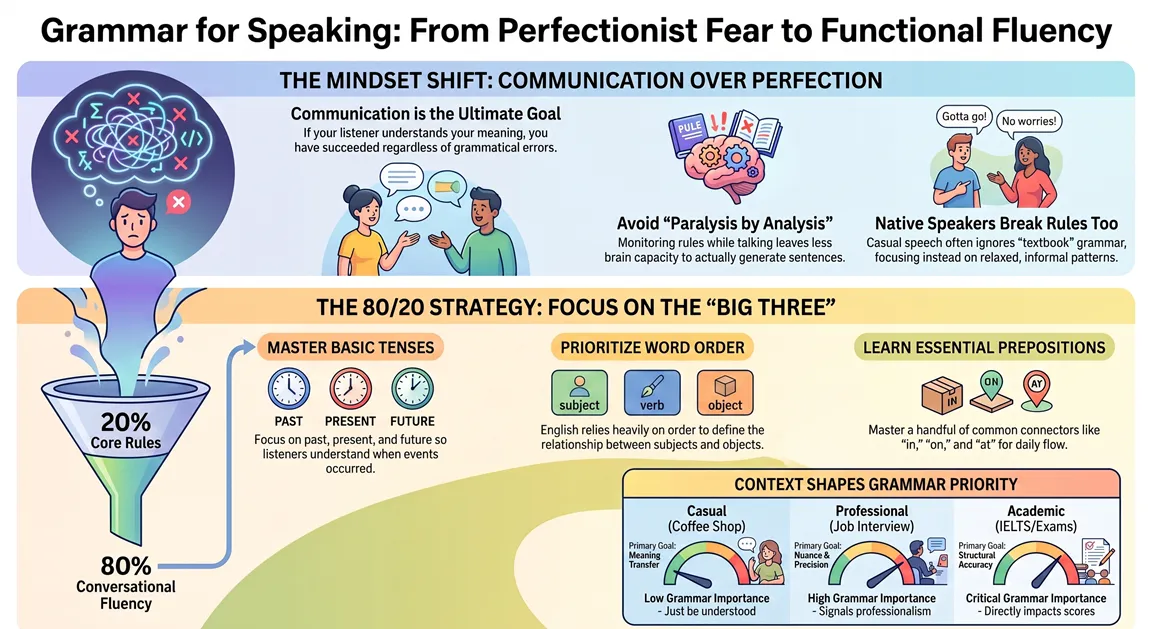
If you wait until your grammar is perfect before you speak, you’ll wait forever. This is sometimes called “paralysis by analysis”: the more your brain monitors rules while you talk, the less capacity it has left to actually generate the sentence — which leads to more mistakes, or to silence.
Think about learning to drive. You don’t master a car by reading the manual in your bedroom. You learn by getting behind the wheel, feeling the road, and yes, occasionally stalling the engine. Speaking English works the same way. Fluency is built through messy repetition, not flawless preparation.
Does Grammar Matter in Spoken English? What Native Speakers Actually Do
Here’s something that surprises a lot of learners: native speakers break “textbook” grammar constantly in casual speech. You’ll hear “There’s two options” (ignoring plural agreement) or “Me and my friend went” (using the wrong pronoun case) in everyday conversation, all the time.
From a linguistic point of view, these aren’t always errors — they’re often informal patterns specific to relaxed, spoken registers. If native speakers themselves don’t follow the textbook version of English when they talk, it’s worth asking why you’re afraid their standard will judge you for the same thing.
That said, context changes the stakes. Ordering a coffee and presenting in a job interview are not the same situation. In interviews, meetings, and written communication, accurate grammar signals preparation and professionalism — and grammar also lets you express more precise ideas (“I would like” instead of “I want,” for politeness and nuance). If you’re preparing for an exam like IELTS or Cambridge, examiners are specifically scoring your sentence structure and verb forms, so grammar accuracy genuinely counts there in a way it doesn’t at the coffee counter.
Which Grammar Is Most Important for Speaking English?
| Focus On | Why It Matters for Speaking |
|---|---|
| Tenses | Help listeners understand when something happened. |
| Word Order | Keeps your message clear and easy to understand. |
| Prepositions | Connect ideas naturally in everyday conversation. |
If you’re overwhelmed by grammar books, stop trying to learn all of it. Around 20% of English grammar covers roughly 80% of what you need to be understood in conversation. Focus on three things:
- Tenses — so your listener knows when something happened. Even a simplified system (past / present / future) gets you understood far more often than word-perfect vocabulary with no sense of time.
- Word order — English relies on word order more than almost any other feature to carry meaning, because the language has very little verb agreement. “The dog bit the man” and “The man bit the dog” use identical words in a different order, with opposite meanings. Get the order right and a lot else can be forgiven.
- Prepositions — the small connector words (in, on, at, to, for) that link your ideas together. They’re notoriously tricky because they rarely translate directly from other languages, but a handful of common ones cover most daily conversation.
Master these three, and you have the minimum structure needed to be understood almost anywhere — a foundation you can then build on through real conversation.
Can I Speak English Without Grammar?
At a very basic level, yes — for short, simple exchanges (ordering food, asking for directions, greeting someone), a few nouns and verbs strung together can get your message across, the way “Me want food” does. Many learners do communicate this way in early stages, and it isn’t a failure.
But there’s a ceiling. Without any grammar, you can survive short transactions; you can’t hold a real conversation, explain a complex idea, or negotiate something important, because meaning gets lost in translation-style sentences. The honest answer is: you can start speaking without grammar, but you can’t stop there if you want real fluency.
How Important Is Grammar in English, Really?
Experts genuinely disagree on the emphasis, and it’s worth knowing both sides instead of picking one blindly. Stephen Krashen, a well-known linguist, argues that grammar rules aren’t the most important input — we acquire language best through understanding messages we hear and read, not through memorizing rules. Diane Larsen-Freeman, another respected linguist, argues the opposite emphasis: grammar isn’t just abstract rules, it’s also about meaning and use, and it helps learners communicate better when it’s taught in context, alongside real practice.
Put simply: grammar study speeds up your progress because it turns thousands of individual sentences into a small number of reusable patterns. Once you understand how the past tense works, you don’t need to memorize “walked,” “studied,” and “travelled” as separate facts — you already have the rule. But grammar study alone, without speaking, doesn’t produce speakers. The two need each other.
Grammar as a Byproduct, Not a Prerequisite
Try flipping the usual order: instead of treating grammar as something you must finish before you’re “allowed” to speak, treat it as something that gets refined by speaking. Children don’t start with textbooks — they listen, imitate, and get corrected in real conversations until the patterns become automatic. Adult learners can use the same loop: speak first, notice the gaps, then study exactly the grammar point that tripped you up. It sticks better because you already felt the need for it.
Quick Answers to Common Questions
Is grammar necessary to speak English?
Some grammar is necessary to be understood clearly; perfect grammar is not necessary to speak. Basic tenses, word order, and prepositions cover most everyday conversation.
Can I speak English without grammar?
For very short, simple exchanges, yes. For real conversations and professional situations, you’ll need at least the core grammar patterns to avoid being misunderstood.
Does grammar matter in spoken English?
Less than in writing or exams, but it still matters — especially in professional or formal settings, where accuracy signals preparation. In casual conversation, being understood matters more than being perfect.
Which grammar is most important for speaking English?
Tenses, word order, and prepositions. These three cover the largest share of everyday spoken communication.
The Bottom Line
Grammar is not a wall you must climb before you’re allowed to speak English. It’s a set of tools that get sharper the more you use them. Start with the basics — tenses, word order, prepositions — and let the rest of your grammar improve through real conversation, not silent study.
The fastest way to build that habit is speaking regularly with someone who can gently correct you in the moment, the way native speakers learn as children — through use, not through fear.
Ready to stop overthinking and start speaking? Book a trial lesson and get real conversation practice with feedback that actually sticks.