


Have you ever watched an English movie, listened to a podcast, or read an article and understood almost every word? Then, ten minutes later, someone asks you a simple question in English, and your mind goes blank.
You know the vocabulary. You’ve studied the grammar. But your mouth just… doesn’t move.
If this sounds familiar: you are not “bad at English.” You are not broken. You’ve simply built one half of the skill and left the other half untrained. This article explains exactly why that happens — and gives you five practical ways to fix it, starting today.
| What Happens | Why It Happens | What to Do |
|---|---|---|
| You understand conversations but freeze when speaking. | Recognition is easier than recalling words under pressure. | Summarize what you heard in your own words. |
| You know lots of grammar but can’t use it naturally. | Grammar knowledge isn’t the same as speaking practice. | Use one grammar pattern in real conversations every day. |
| You wait until you feel confident. | Confidence grows after successful attempts, not before. | Record a 2-minute voice memo daily. |
| You keep making the same mistakes. | Self-practice doesn’t provide corrective feedback. | Get regular feedback from a tutor or speaking partner. |
| You spend most of your time consuming English. | Input improves comprehension, while output builds fluency. | Balance every study session with speaking practice. |
You’re Not Alone — Here’s the Real Reason
Language has four skills: reading, listening, writing, and speaking. The first two — reading and listening — are input skills. You receive information. The last two — writing and speaking — are output skills. You produce it.
Most learners spend the vast majority of their study time on input: watching, reading, listening. Language teachers often estimate learners put roughly seven times more effort into input than output. That imbalance isn’t a personal failure — it’s just what happens when “studying English” quietly becomes “consuming English.”
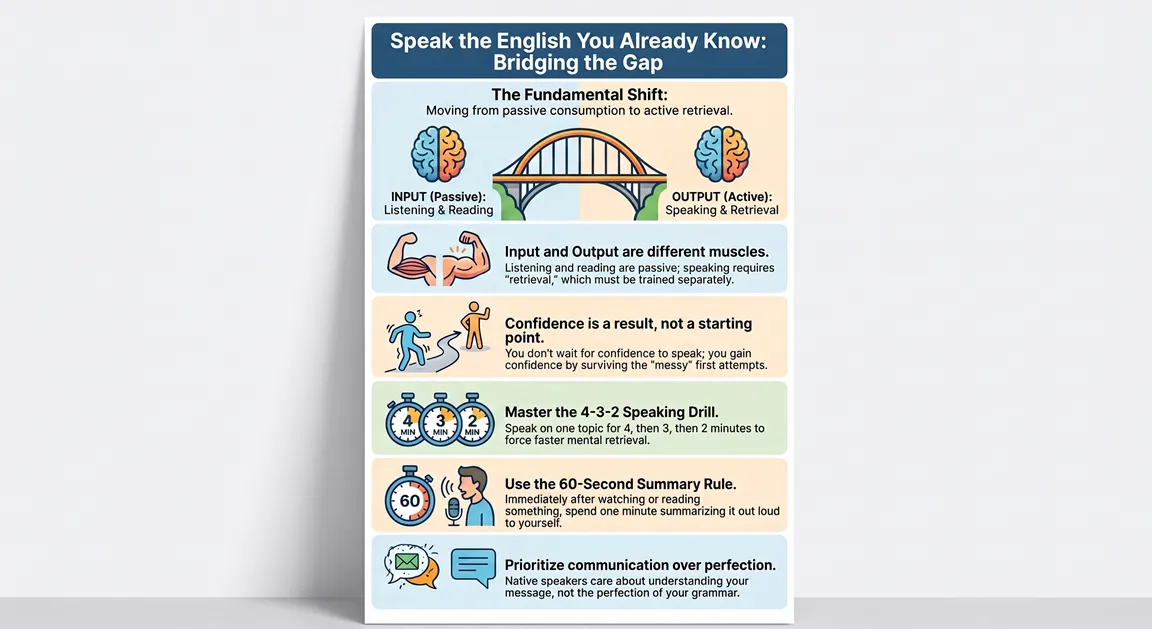
Here’s the problem: input and output are different skills. Understanding a word when you hear it and retrieving that same word from memory, under time pressure, while building a sentence — these use different mental muscles. You’ve been training one and expecting the other to show up on its own. It won’t. Not without practice.
Here are five truths that will help you close that gap.
Truth #1: You’re Training Your Arms but Expecting Strong Legs
Think of it like the gym. If you train only your arms, don’t be surprised when your legs give out on a run. It’s the same with English: watching and reading build your “arms” — vocabulary and comprehension. But speaking is a separate muscle, and you only build it by using it.
Or think of painting. Watching a video about brush technique is genuinely useful. But until you actually pick up a brush and feel the paint resist the canvas, you are not yet a painter. You’re a very well-informed spectator.
Try this: talk to an imaginary friend. Once a day, pick something you just watched, read, or heard, and explain it out loud — alone, in your own words — as if you’re telling a friend about it. Your commute, your shower, cooking dinner: any five minutes work. This feels strange the first few times. That’s normal. It’s also exactly the exercise that turns passive vocabulary into active vocabulary, because you’re forced to retrieve words instead of just recognizing them.
Truth #2: Confidence Is a Conclusion, Not a Starting Point
One of the biggest traps learners fall into: waiting to feel confident before they speak.
Here’s the problem with that plan — confidence doesn’t arrive first. Your brain builds confidence from evidence. Every time you speak, even badly, even with mistakes, you’re handing your brain a data point: “I tried, and I survived.” Enough of those data points, and your brain draws its own conclusion: “I can actually do this.”
Waiting to feel ready before you speak is like waiting to feel strong before you go to the gym. The feeling comes after the reps, not before them.
Try this: record a 2-minute voice memo, today. Open your phone. Talk about your day in English for two minutes. No script, no notes, no perfect version. Listen back if you want, or delete it — the recording isn’t the point. The point is that your brain now has one more piece of evidence that you can do this. Do it again tomorrow.
Truth #3: The Perfectionist’s Paradox Is Silencing You
Many learners stay quiet because they’re afraid of a grammar mistake or a strong accent. This creates a paradox: you want to speak perfectly, so you don’t speak — which guarantees you never get the practice you need to actually improve.
Here’s some real perspective: most native speakers aren’t judging your grammar. Many are impressed you’re making the effort at all. And remember — most English conversations happening in the world right now are between two non-native speakers. That’s not a lesser version of English. That’s just what global English looks like today.
If you’re naturally shy or introverted, that’s a personality trait, not a fluency disqualifier. You don’t need to become a different person. You need a practice plan that fits the person you already are: practising alone before practising with others, preparing a few sentences before a call, starting with one person you trust instead of a group.
The goal was never perfection. It was always communication.
| Passive Learning (Input) | Active Practice (Output) | Result |
|---|---|---|
| Watch a YouTube video | Explain it in your own words | Better word retrieval |
| Read an article | Summarize it aloud | Stronger speaking fluency |
| Learn new vocabulary | Use it in a short story | Active vocabulary |
| Study grammar | Speak using the new structure | Natural sentence building |
| Listen to a podcast | Record a 2-minute response | Faster thinking in English |
Truth #4: The 4-3-2 Method Trains Your Brain to Retrieve Words Faster
This is one of the most effective drills for bridging the gap between “I know this word” and “I can say this word in real time.”
- Step 1 — 4 minutes: Choose a topic (your weekend, your job, a news story) and speak about it out loud for four minutes. Don’t stop for mistakes — keep going.
- Step 2 — 3 minutes: Speak about the exact same topic again, but now in three minutes. Try to go deeper on one detail, or use a new word you know but rarely use.
- Step 3 — 2 minutes: Summarize the whole thing in two minutes.
The time pressure is the trick. Saying the same content in less time forces your brain to stop translating in your head and start pulling words directly from memory. By round three, most learners notice fewer “umms,” smoother sentences, and less mental lag between thinking and speaking.
A few topics to keep ready: your typical work day, a decision you’re currently facing, a place you’d like to travel, something that annoyed you this week. Real topics work better than abstract ones — you already have the ideas, you just need the words.
Truth #5: 5 Minutes of Speaking Beats 30 Minutes of Watching
The most common excuse is “I don’t have time to practice.” But speaking is studying — arguably the most effective kind there is.
Picture watching a chef make pizza on YouTube every day for a month. You’ll understand the technique perfectly. But if you never step into a kitchen yourself, you still won’t be able to toss the dough. Comprehension and skill are not the same thing.
Try this: the 60-second rule. Right after you finish a video, a podcast episode, or an article, spend 60 seconds summarizing it out loud, to yourself, before you move on. This single habit converts a passive hour into active practice — without adding any extra time to your day. Same input, different result.
“But I Don’t Have a Native Speaker to Practice With”
This is a real concern, and here’s the honest answer: you don’t strictly need one. Fluency comes from producing language and being understood — that happens in conversation with anyone: a classmate, a colleague, a language partner, even yourself, out loud, recording your own voice.
But here’s what practising alone can’t give you: someone telling you what’s actually wrong. You can repeat the same mistake in your imaginary-friend conversations for a year and never notice it, because there’s no one there to catch it. That’s the one gap self-practice can’t close — and it’s the difference between speaking more and speaking better. A tutor’s job isn’t to be a conversation partner you technically don’t need; it’s to be the feedback loop you can’t give yourself.
The Right Time Is Now
Fluency isn’t reserved for the “naturally gifted.” It’s built through small, imperfect, repeated actions — each one a data point your brain uses to draw its own conclusion: I can speak English.
Stop waiting for the perfect vocabulary, the perfect moment, or the perfect partner. What’s one thing you could say out loud, right now, in English?
Want faster progress, with someone catching what you can’t hear yourself? [Book a trial lesson with Shadi at shadienglish.com] — real conversation practice, with feedback built in, not left out.
Frequently Asked Questions
Why do I understand English but can’t speak it? Because understanding (input) and speaking (output) are different skills trained in different ways. Reading and listening train recognition — your brain matching sounds or words to meaning it already knows. Speaking trains retrieval — pulling the right word out of memory and building a sentence in real time, under pressure. If you’ve spent most of your study time on input, your output skill simply hasn’t had the practice it needs yet.
I understand English but can’t speak fluently — what should I do first? Start smaller than you think you need to. A 60-second spoken summary after anything you watch or read, or a 2-minute voice memo about your day, is enough to begin closing the gap. Consistency matters far more than session length.
I can understand English but not speak it — is this normal? Yes, extremely common — most learners experience exactly this stage. It isn’t a sign that you’re “bad” at English. It’s a sign that your input skills have outpaced your output practice, which is the default outcome of most traditional English study.
How long does it take to go from understanding English to speaking it confidently? There’s no fixed timeline — it depends on how often you actively practice, not how much you passively consume. Learners who add daily short speaking drills (like the 4-3-2 Method or the 60-second rule) typically notice smoother, faster retrieval within a few weeks, though real fluency builds over months of consistent output practice.
Do I need a native speaker to improve my speaking? No — producing language with anyone (a classmate, a language partner, or even yourself out loud) builds the same retrieval skill. What self-practice can’t give you is feedback on what’s actually wrong. That’s where a tutor’s correction — not conversation for its own sake — makes the difference.