


You studied English for years. Your grammar is strong. Your vocabulary is big. But sometimes, someone in a meeting still asks you to repeat yourself. Or you notice your “Could you…?” comes out sounding a little too direct — more like an instruction than a request.
If this sounds familiar, here’s the important part: this isn’t about your English level. It’s about a few physical habits your mouth learned in German — and habits can change.
| German Accent Habit | What It May Sound Like | Example | What to Work On |
|---|---|---|---|
| Final consonants | bad → bat | bad / bat | Keep the final sound voiced |
| Flat sentence stress | Speech sounds even or mechanical | “I need the report today.” | Stress key words |
| Weak schwa | Every syllable sounds equally clear | computer | Relax unstressed syllables |
| German R | R sounds too far back in the throat | right / around | Move the R to the tongue |
| Vowel confusion | Similar words become unclear | walk / work | Change mouth & tongue position |
| Mixed accents | Pronunciation sounds inconsistent | British + American features | Choose one target accent |
| Poor sound awareness | You don’t notice your own errors | thin / sin | Train your listening first |
I’ve spent years helping German-speaking professionals sound clearer in English, and I see the same patterns again and again. In this guide, I’ll show you the five deeper habits most guides miss, and exactly how to fix them, with free practice you can start today.
The two sounds you probably already know about
Most German speakers already know the two classic problem sounds: W and TH.
- W — German doesn’t have this sound, so it often becomes a V. Round your lips like you’re about to blow out a candle, and pull the back of your tongue up slightly. Don’t let your teeth touch your lip. Try: “window,” not “vindow.”
- TH — German has no TH sound, so it often turns into S, Z, or D. There are actually two TH sounds: a voiceless one with no vibration in your throat (“think,” “three”), and a voiced one with a small buzz in your throat (“this,” “that”). For both, put the tip of your tongue lightly between your teeth and push air out gently.
A few days of focused practice usually fixes these two. But here’s the real problem: many German speakers fix W and TH perfectly and still get asked to repeat themselves. That’s because of five deeper habits.
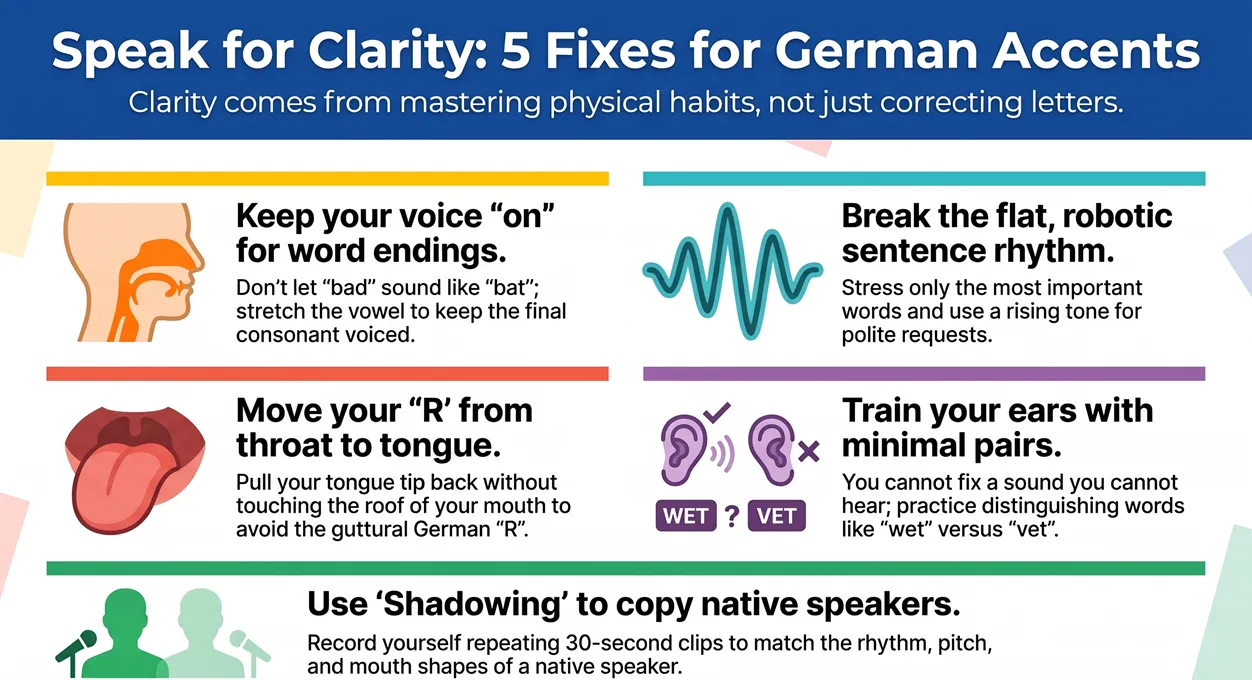
Fix 1: Your word endings disappear
In German, a letter like d, g, or b at the end of a word is pronounced as t, k, or p. This is completely normal — it’s why “Hund” sounds like “Hunt.” But in English, this habit changes the meaning of the word.
This is one of the biggest reasons people ask German speakers to repeat themselves. “Bad” can sound exactly like “bat.” “Big dog” can sound like “big dock.”
How to fix it
Keep your voice “on” all the way to the end of the word. One easy trick: stretch the vowel just before that last letter a little. So “bad” becomes “baaa-d” — longer and softer — while “bat” stays short and sharp. The extra length tells the listener’s ear that the ending is voiced, meaning your vocal cords are vibrating.
Try these pairs out loud, slowly, with your hand on your throat. You should feel a small buzz on the first word and nothing on the second:
- bad / bat
- dog / dock
- big / pick
- save / safe
- bag / back
Free practice: search “Ending Voiced vs. Unvoiced Consonants” on Rachel’s English (YouTube) — a short video with slow-motion mouth shots, so you can see the difference, not just hear it.
Fix 2: Your sentences sound flat, or too strict
English leans on a few key words in each sentence, making them louder and longer, while the rest go quiet and fast — almost swallowed. German tends to give syllables more even, clear weight. If you pronounce every syllable clearly, the way you probably learned in school, your English will still sound a little flat and mechanical.
There’s a second part. German often ends sentences with a flat or falling tone. In English, that same falling tone on a request can make “Could you send that file?” sound like a command instead of a polite ask.
How to fix it
- In each sentence, pick one or two words that carry the real meaning. Say only those a little louder and slower. Let the rest go quiet and fast.
- Stop pronouncing every ending fully. The “er” at the end of “computer” isn’t a full sound — it’s a short, relaxed “uh” called the schwa, the most common sound in English. Let it blur.
- For real questions and polite requests, let your voice go up a little at the end instead of down. That small change makes you sound like you’re asking, not telling.
Free practice: search “How to Pronounce the Schwa” on Rachel’s English — a two-minute video on that soft, relaxed sound, and one of the fastest ways to sound more natural.
Fix 3: Your R and your vowels are in the wrong place
The standard German R comes from the back of the throat (some regions use a rolled R with the tongue — both are different from English). The English R comes from the tongue: the tip pulls back and curls slightly, but never touches the roof of your mouth. If your R still comes from your throat, it will sound foreign even in a perfect sentence.
Vowels have the same kind of problem. Compare two words that confuse many German speakers:
- Walk — round your lips into an open “O” shape, drop your jaw
- Work — keep your mouth relaxed and centered, pull your tongue back
These aren’t small details — they’re two completely different words. And the mix-up here isn’t about the W sound; it’s about the shape of the vowel and where your tongue sits for the R.
How to fix it
Practice in front of a mirror. Say “walk” and “work” back to back and watch whether your mouth shape actually changes. If this feels strange to do on purpose, that’s normal — you’re building a new movement, not doing something wrong.
Singing in English also helps. Songs make you hold vowels for their full length instead of cutting them short, and that trains the same muscles you need for clear speech. This is exactly the kind of habit that’s hard to hear in your own voice — a tutor who can record you and point out these small movements saves months of guessing alone.
Fix 4: You picked a target accent by accident
Most learners default to American English without ever choosing it. But your target accent should match who you actually talk to at work. American clients? Aim for an American model. European or British colleagues? Aim for British.
Why does this matter? If you mix accents — an American R with British vowels, for example — your speech becomes harder to follow, even if every sound is technically “correct.”
How to fix it
- Pick one accent and commit to it for at least three months.
- Find one or two speakers — podcasters, YouTubers, actors — who speak that accent clearly.
- Listen to them for 10 minutes a day and notice how they shape their vowels and where they put their stress.
One extra note, not a rule: some German speakers find British Received Pronunciation (the “standard” British accent) a slightly easier first step, since a few of its sounds sit closer to German. That’s worth knowing, but your business network should be the main reason you choose.
Fix 5: You can’t fix a sound you can’t hear
This is the part most guides skip. If your English already sounds correct to you, but people still ask you to repeat yourself, the gap isn’t in your mouth — it’s in your ear. You literally can’t hear the difference yet. Train your ear first, and your mouth will follow.
Step 1 — Minimal pairs
Minimal pairs are word pairs that differ by only one sound: thin/sin, wet/vet, bat/bad. Have a friend, or an app, say them in random order, and guess which one you heard. Don’t try to pronounce them yet — just listen. Fifteen minutes a day is enough to start noticing differences you couldn’t hear before.
Step 2 — Shadowing
Shadowing means repeating right after a native speaker, like an echo:
- Pick a short clip (30–60 seconds) of a native speaker who sounds the way you want to sound.
- Play a few seconds, then repeat it right after — copy the rhythm and melody, not just the words.
- Record yourself and compare it to the original. Ask: did I keep my endings voiced? Is my R in my throat or on my tongue?
Free practice: Rachel’s English (YouTube) breaks down American sounds one at a time. Accent’s Way with Hadar focuses on rhythm and intonation. Both are excellent for shadowing.
Here is a quick cheat sheet of everything we just covered. Screenshot this on your phone or print it out to use during your daily practice:
| The Habit | Practice Pairs / Sentences | What to Notice (The Physical Feeling) |
|---|---|---|
| Word endings | bad / bat dog / dock save / safe | Is your throat still vibrating at the end of the first word? |
| Sentence rhythm | I need the REPORT today. | Make the key word longer; let the small words go quiet and fast. |
| The “Schwa” | computer, teacher, about | Relax the unstressed vowels into a soft, lazy “uh”. |
| The English R | right, around, career | Keep your tongue pulled back so it never touches the roof of your mouth. |
| Vowel shapes | walk / work ship / sheep | Look in a mirror: does your mouth shape actually change between the two? |
| Polite questions | Could you send that file? | Let your voice melody go up slightly at the end, not down. |
| Ear training | thin / sin wet / vet bat / bad | Can you hear the exact difference before you try to speak? |
One honest note: phone calls feel worse
If your accent feels much stronger on the phone than in person, that’s completely normal — it doesn’t mean you’re worse than you think. Phone calls remove lip-reading and body language, so the listener has fewer clues. This is exactly why Fix 1 and Fix 2 matter most: on a call, your word endings and your rhythm are almost all the listener has to work with.
Overcoming a German accent: clarity, not perfection
Let’s be clear: the goal was never to erase where you’re from. Plenty of highly effective international professionals keep a light accent their whole careers, and that’s perfectly fine. The goal is to remove the specific habits that make people ask you to repeat yourself, so they focus on your ideas, not your pronunciation.
Self-practice will get you most of the way. But here’s the honest truth: it’s very hard to hear your own blind spots. A trained ear can spot your specific patterns in minutes — patterns you might spend months guessing at alone.
If you want someone to listen to you, find your exact patterns, and build a clear plan to fix them, that’s exactly what one-on-one lessons are for. Book a trial session today — in our first class together, we’ll identify your top three pronunciation habits, and you’ll leave with a personal practice plan you can start using the same day.