


You closed a big deal in your native language this morning. This afternoon, you’re rehearsing a simple English sentence in your head before you say it out loud. That gap feels strange. It can even feel a little embarrassing.
If you’ve typed “can I still learn English in my 40s?” into Google late at night, you’re not alone — and the honest answer is yes. Not “yes, technically.” Yes, clearly, with good evidence behind it.
| Challenge | What Many People Assume | What the Research and Experience Suggest |
|---|---|---|
| Learning after 40 | I’m too old to learn English. | Adults can make rapid progress, especially in the early stages, because they learn more consciously. |
| Grammar | Children learn grammar more easily. | Adults often understand grammar rules faster thanks to existing learning and problem-solving skills. |
| Pronunciation | An accent means failure. | Clear communication matters far more than sounding like a native speaker. |
| Time | You need hours of free time every day. | Short, consistent practice sessions (10–30 minutes) are far more effective than occasional long study sessions. |
| Vocabulary | You must memorize long word lists. | Learning words through topics you genuinely enjoy leads to better retention. |
| Speaking Confidence | You should wait until your English is “good enough.” | Speaking early—even with mistakes—is one of the fastest ways to improve. |
| Immersion | You must move abroad to become fluent. | Regular listening, speaking, and structured lessons can produce excellent results without relocating. |
Is 40 too late to learn a new language? Here’s what the research actually says
For years, people believed that language learning has a “critical period”, a window in childhood that closes forever. That idea comes from a 1967 theory by linguist Eric Lenneberg, who argued that after about age 13, native-level fluency becomes impossible.
It’s a catchy idea. It’s also never been proven. Researchers still disagree on how you would even test it fairly.
One well-known study, by researchers Catherine Snow and Marian Hoefnagel-Höhle, followed different age groups learning Dutch. The result surprised a lot of people: adults and teenagers made the fastest progress in the first few months, faster than young children. The children only caught up, and only partly, after a full year of daily exposure at school.
So here’s the more accurate picture: children who grow up abroad often reach a very high level in the long run, but that’s mostly because they get years of full-day immersion, not because their brains have some special switch that adults have lost. Give an adult the same level of structured practice, and progress can be just as real, often faster.
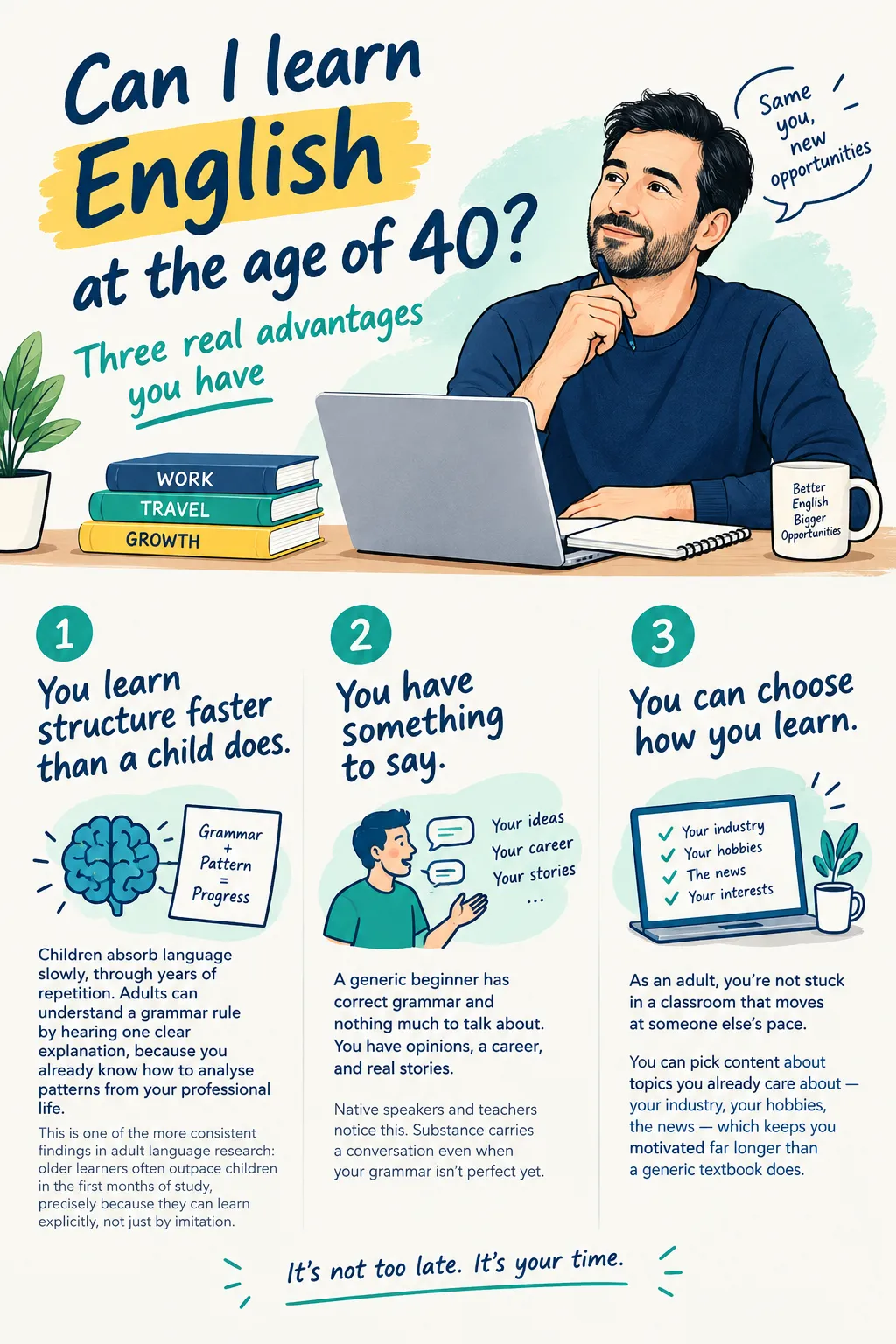
Can I learn English at the age of 40? Three real advantages you have
You’re not learning from zero. You’re learning with thirty or more years of practice at learning things, working with people, and solving problems. That matters more than most people realise.
- You learn structure faster than a child does.
Children absorb language slowly, through years of repetition. Adults can understand a grammar rule by hearing one clear explanation, because you already know how to analyse patterns from your professional life. This is one of the more consistent findings in adult language research: older learners often outpace children in the first months of study, precisely because they can learn explicitly, not just by imitation.
- You have something to say.
A generic beginner has correct grammar and nothing much to talk about. You have opinions, a career, and real stories. Native speakers and teachers notice this. Substance carries a conversation even when your grammar isn’t perfect yet.
- You can choose how you learn.
As an adult, you’re not stuck in a classroom that moves at someone else’s pace. You can pick content about topics you already care about — your industry, your hobbies, the news, which keeps you motivated far longer than a generic textbook does.
How to learn English at 40 years old (without finding extra hours you don’t have)
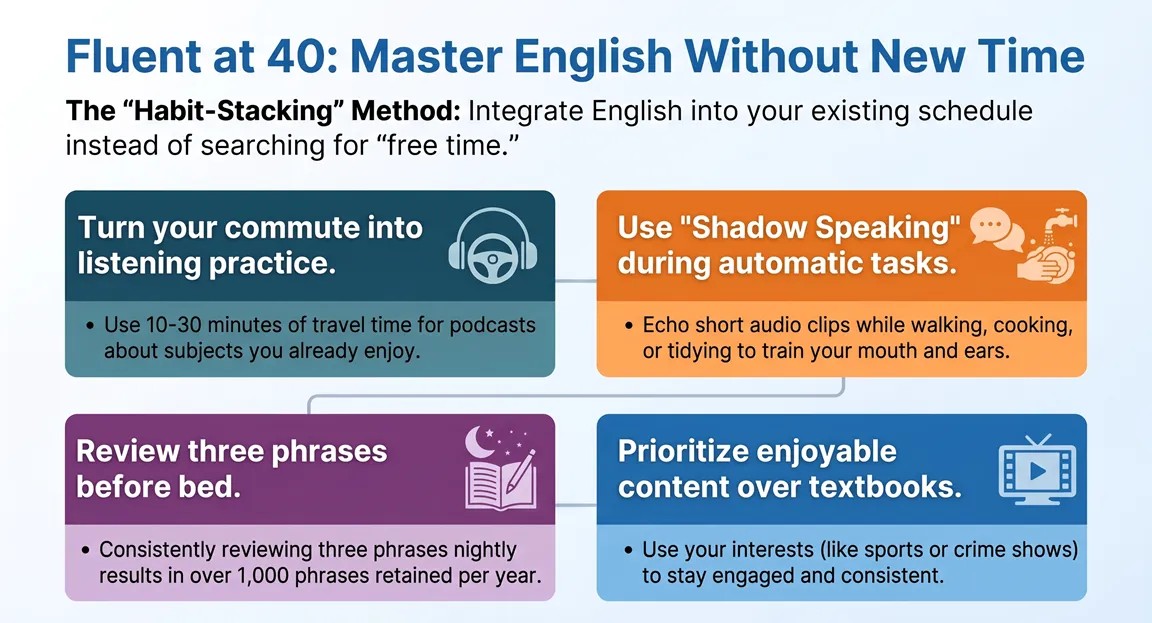 The biggest real barrier at this age isn’t your brain. It’s your calendar. So the goal isn’t to “find” time, it’s to attach English to time you’re already spending on something else.
- Turn your commute into listening practice. Ten to thirty minutes of a podcast or conversation about something you already enjoy, business, travel, your industry, adds up to real, cumulative exposure without taking anything off your schedule.
- Try “shadow speaking.” While you’re doing something automatic, walking, cooking, tidying up, play a short audio clip and repeat it right after, like an echo. This trains your mouth and ear together, in private, with zero pressure.
- Review three phrases before bed. Just three. Sleep plays a real role in how the brain consolidates new information. Three phrases a night, done consistently, adds up to over a thousand phrases a year, which is far more than most learners actually retain from a crammed weekly lesson.
- Spend most of your time on content you actually enjoy. Textbooks and grammar drills matter, but they shouldn’t be the majority of your week. If you like true crime, watch it in English. If you follow football, read match reports in English. Interest keeps you coming back; textbooks alone rarely do.
None of this requires a two-hour block you don’t have. It requires making English a habit that rides along with habits you already have.
Will you sound exactly like a native speaker? Probably not — and that’s fine
Here’s the part most “you can do anything!” articles skip, and it’s worth being honest about: if you start at 40, you likely won’t end up sounding identical to someone who grew up speaking English. Native-like pronunciation, down to the last detail, is genuinely harder to fully acquire as an adult, and it’s fair to expect an accent to remain.
That’s not the same as failing. Clear, confident, fluent English with a trace of an accent is not a lesser version of English, it’s simply your English. Plenty of the most effective communicators in international business speak with an accent. What actually determines whether people understand you and want to keep talking to you is clarity, listening skills, and confidence, not how close you sound to a BBC newsreader.
| Time | Activity | What to Do | Goal |
|---|---|---|---|
| 5 min | Phrase review | Review 3 useful phrases from yesterday | Retention |
| 7 min | Listening | Listen to a short podcast/video about a topic you enjoy | Comprehension |
| 5 min | Shadow speaking | Repeat selected sentences immediately after the speaker | Pronunciation & fluency |
| 3 min | Speaking | Say a few sentences about your day or work | Confidence |
Your next five minutes
You don’t need a two-hour study marathon this weekend. You need one five-minute window tomorrow, a commute, a coffee break, the walk to your car, where you let English in.
If you’d rather not figure this out alone, that’s exactly where working with a teacher helps: lessons built around your schedule, your industry, and the English you actually need, not a generic textbook chapter. That’s the whole idea behind working one-to-one instead of in a course built for nobody in particular.
Frequently asked questions
Can I still learn English in my 40s?
Yes. Studies on adult language acquisition consistently show adults can make fast, real progress, especially in structured, explicit learning, which is exactly how most adult English lessons work.
Is 40 too late to learn a new language?
No. There’s no proven age at which language learning becomes impossible. What changes with age is available time and comfort with sounding imperfect in front of others, not your underlying capacity to learn.
How long does it take to learn English at 40?
It depends on your starting level, your goal, and how consistently you practise, but with regular exposure (even in short daily doses) and real conversation practice, most adult learners see a noticeable level jump within several months to a year.
Do I need to move abroad to learn English properly?
No. Immersion abroad helps, but it’s not the only path. Consistent listening, speaking practice, and working with a teacher who tailors lessons to your actual life and goals can get you fluent without relocating.