

You study 20 new words in one evening. The next morning, you remember two.
If this happens to you, you are not alone, and you are not “bad at languages.” Your brain is not broken — it is just doing its job. This article shows you exactly how to remember English words forever, using methods that real learners and teachers actually use, not vague advice like “just practice more.”
Why You Forget New Words (And Why It’s Not Your Fault)
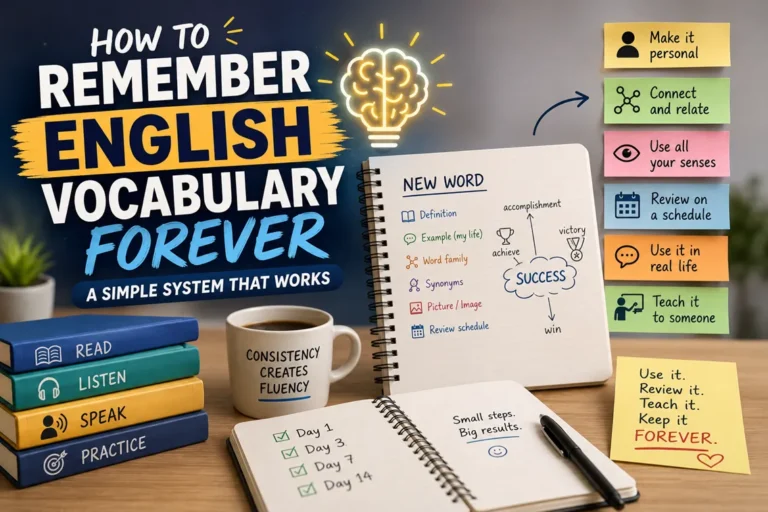
| Technique | What to Do | Example |
|---|---|---|
| Make It Personal | Connect the word to your own life. | confident → “I felt confident today.” |
| Learn Word Families | Study related forms together. | create → creation → creative |
| Use Synonyms | Learn similar words. | happy → pleased, glad |
| Create Mnemonics | Make a funny memory link. | bulk → Think of The Hulk |
| Use Your Senses | Write, say, picture, and act it out. | Say “stretch” while stretching. |
| Review Regularly | Review on Days 1, 3, 7, and 14. | Spaced repetition |
| Test Yourself | Recall before checking. | Cover the definition first. |
| Learn from Context | Watch videos, read stories, listen to podcasts. | Write down useful words. |
| Teach the Word | Explain it in simple English. | Teach a friend or yourself. |
There are two simple reasons new words disappear:
- You don’t use them. If you don’t review a word, your brain treats it as unimportant and lets it fade. This is called the forgetting curve — most of what we learn is lost within a day or two if we never look at it again.
- You can’t find it, even though it’s there. Sometimes the word is still in your memory, but you have no way to “pull it out.” Give yourself a small clue — for example, “it’s a fruit” — and the word often comes back immediately. Teachers call this cue-dependent forgetting: the information didn’t vanish, it just needs the right key to unlock it.
The fix for both problems is the same: stop reading word lists once and hoping for the best, and start using words in ways your brain actually remembers.
Step 1: Make the Word Personal, Not Abstract
A word with no connection to your life is easy to forget. A word connected to your day, your feelings, or your story is hard to forget.
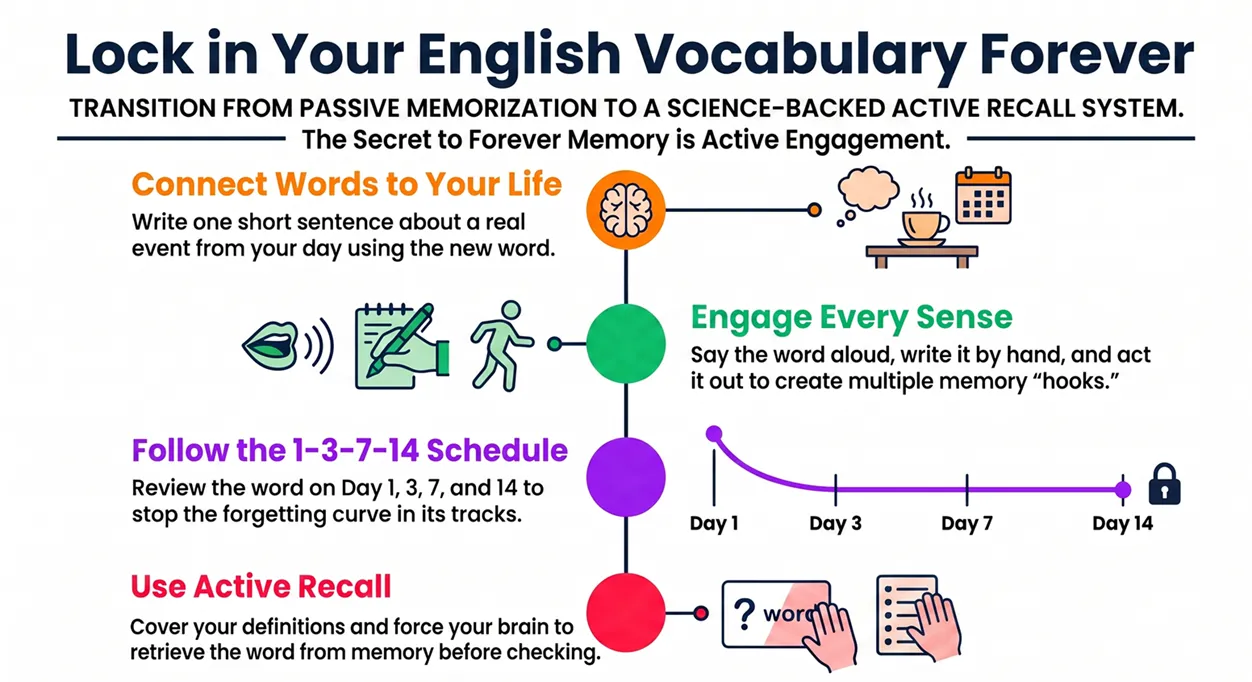
Try this: Pick 3–5 new words. Write one short sentence for each, about something that actually happened to you today.
- organize → “I need to organize my desk before the meeting.”
- frustrated → “I felt frustrated when my internet stopped working.”
- confident → “I felt confident after my English class today.”
This takes two minutes and works far better than repeating a word 20 times with no context.
Step 2: Connect New Words to Words You Already Know
Your brain remembers networks of words much better than single, isolated words.
Word families: When you learn one word, learn its family too.
- create → creation → creative
- decide → decision → decisive
Synonyms: Pick a word, then find 2–3 words that mean something similar.
- difficult → challenging, tough, demanding
- happy → pleased, glad, content
Simple memory tricks (mnemonics): Link a new word to something silly or familiar so it sticks.
- Bulk (a large amount) → picture The Hulk carrying a huge bag of rice.
- To spell “accommodation,” remember it has two Cs and two Ms.
These tricks feel small, but they give your brain a “hook” to hang the word on.
Step 3: Use All Your Senses
Reading a word silently is the weakest way to learn it. The more senses you involve, the stronger the memory.
- Write it by hand. Typing is fast, but writing by hand helps memory more.
- Say it out loud. Say it normally, then try saying it happily, angrily, or in a whisper. This feels silly — that’s exactly why it works.
- Picture it. Close your eyes for five seconds and imagine a small scene with the word in it. Don’t just picture the object — imagine the smell, the sound, or how it feels.
- Act it out, if you can. Jump when you learn “jump.” Stretch when you learn “stretch.” Physical movement creates a memory that’s hard to erase.
Step 4: Review on a Schedule (Not All at Once)
Cramming 50 words the night before doesn’t work — you already know this from experience. Reviewing a smaller number of words on a schedule works much better. This is called spaced repetition, and it’s one of the most well-supported techniques in language learning.
A simple schedule to follow:
| When | What to do |
|---|---|
| Day 1 | Learn the word, use it in a sentence |
| Day 3 | Look at it again, use it in a new sentence |
| Day 7 | Review it once more |
| Day 14 | One final check — it should now feel automatic |
You don’t need to do this by memory. Apps like Anki or Quizlet will remind you automatically, or a simple notebook works just as well — the method matters more than the tool.
What to write in your notebook or app, for every word:
- The word and how to say it
- A short definition in simple English (try explaining it in English, not translating it — this trains your brain to think in English)
- One example sentence about your own life
- Its word family (create/creation/creative)
Test yourself, don’t just re-read. Cover the definition and try to say or write the word from memory before you check. This small effort — called active recall — builds a much stronger memory than simply reading your notes again.
Step 5: Learn Words From Real English, Not Just Lists
Words you meet inside a story, show, song, or conversation are easier to remember than words from a list, because they arrive with a scene attached.
- Watch a short show or video with English subtitles.
- Listen to a podcast about a topic you actually enjoy.
- When you hear a word you don’t know, write it down and look it up later — don’t stop the video every time.
This also solves a common problem: learning words you’ll never actually use. Focus on vocabulary connected to your job, your hobbies, and your daily conversations. Ten useful words beat fifty random ones.
Step 6: Teach It to Someone (Even If It’s Just You)
Here’s a strange but true fact: explaining a word forces your brain to organize it properly, which makes it stick.
You don’t need a student. Try this instead:
- Explain the word to yourself in the mirror.
- Imagine explaining it slowly to a friend who’s never heard it.
- Write one sentence in a notebook about why this word matters to you.
If you can explain it clearly, you’ve actually learned it. If you can’t, that’s useful information too — it tells you exactly which words need more review.
Step 7: Don’t Let Nerves Block Your Words
Have you ever known a word perfectly, then completely forgotten it the moment you needed it in a real conversation? This isn’t a memory problem — it’s a nerves problem. When you feel anxious, your brain focuses on the stress, not on finding the right word.
Small ways to build confidence before you need it:
- Talk to yourself in English while doing chores, so hearing your own voice feels normal.
- Practice with someone low-pressure — a friend, a language partner, or a teacher whose whole job is to help, not judge.
- Remind yourself: the goal of a conversation is connection, not a perfect grammar score.
The calmer you feel, the easier your vocabulary becomes to access.
Notice Your Own Progress
Motivation fades faster than vocabulary does if you never see proof that it’s working. Give yourself real, specific credit when you use a new word successfully — in an email, a meeting, or a conversation. Keep a short running list of words you’ve actually used in real life, separate from your review list. Watching that list grow is often more motivating than the review schedule itself.
Quick FAQ
How do I remember English words forever, not just for a day?
Combine three things: personal example sentences, spaced review (Day 1, 3, 7, 14), and real use in conversation. Skipping any one of the three weakens the result.
How can I remember vocabulary and its definition together?
Keep both in the same place — a notebook or app entry with the word, a simple English definition, and your own example sentence. Reviewing them as one unit is more effective than memorizing words and definitions separately.
Is it better to translate a word or describe it in English?
Describing it in English (even in simple words) trains you to think in English directly, which helps both memory and speaking speed. Translation is a useful shortcut for beginners, but try to move away from it as you progress.
Your Next Step
Reading about these methods is the easy part. The words that truly stay with you are the ones you actually use — in a sentence, out loud, in a real conversation with another person.
That’s exactly where a good teacher makes the difference: someone who gives you real conversations to practice in, corrects you gently, and helps you build the confidence to use new words without fear of making a mistake.
If you’d like to practice your vocabulary in real conversations with a teacher, book a free trial lesson — the fastest way to make new words permanent is to actually use them.