


The “Loading Screen” Feeling
You know the feeling. The other person finishes talking. Then… silence. You’re still buffering — turning their English into your language, building your answer, then turning it back into English. By the time you’re ready, the moment is gone.
This is the “human loading screen” problem. It’s not just slow. It’s tiring. And here’s the good news: it’s not a mistake. Almost every learner does this. The goal isn’t to feel bad about it — it’s to need it less, little by little.
| Habit | What You’re Doing | Why It Slows You Down | Better Alternative |
|---|---|---|---|
| Translating word by word | Thinking in your native language before speaking English | Creates delays and breaks your speaking flow | Think in simple English phrases instead of individual words |
| Memorizing isolated vocabulary | Learning single words without context | Makes it harder to recall words naturally | Learn vocabulary in common phrases and sentences |
| Trying to speak perfectly | Focusing on grammar before speaking | Increases hesitation and anxiety | Aim for clear communication, not perfect grammar |
| Using your native language while studying | Constantly comparing English with your first language | Reinforces the translation habit | Immerse yourself in English as much as possible |
| Speaking too little | Spending most of your time reading or studying | Builds passive knowledge but weak speaking skills | Practice speaking every day, even for 5–10 minutes |
| Translating unknown words | Looking for direct equivalents in your language | Prevents direct understanding in English | Guess meaning from context before using a dictionary |
| Thinking in full sentences first | Planning every sentence before speaking | Slows reaction time in conversations | Respond with short, natural English chunks |
| Depending on bilingual dictionaries | Translating every new word | Keeps your brain connected to your native language | Use English-English dictionaries whenever possible |
It’s OK to Translate at First
Comparing English to your own language helps a lot when you’re starting out. It shows you the pattern: where the verb goes, how questions are built, which sounds are new for you.
The problem shows up later — when you already know basic English, but you still translate full sentences in your head before you speak. That’s the habit to break. Not translating itself. The slow, word-by-word kind.
Simple rule: if an English phrase doesn’t match your language, don’t force it. Just learn it as one piece, the way it is.
Try On a New “English You”
Many learners feel stuck as “the student who makes mistakes.” One reason: they’re still speaking as their normal self — the one who has always needed to translate. Try building an English version of you instead. Someone who just answers in English. No permission needed.
The actor Oscar Isaac is a good real example. His full name is Óscar Isaac Hernández Estrada. Early in his career, casting directors kept offering him the same type of role because of his name. So for auditions, he started using just “Oscar Isaac.” It opened new doors. The lesson isn’t about names — it’s that a small change in identity can remove a limit you didn’t know was there.
Want real practice, not just theory? Shadi runs 1-on-1 English lessons for adult professionals who want to speak with confidence — no grammar drills, just real conversation. [Book a free intro call →]
Use the Dictionary Less, Not Never
A dictionary is a great tool for a beginner. It becomes a problem when you reach for it mid-conversation, every time a word is hard.
Two reasons this slows you down. First, word-for-word translation is often wrong — the word “left” can mean a direction or the past of “leave.” Only the sentence around it tells you which. Second, stopping to check your phone breaks the conversation completely.
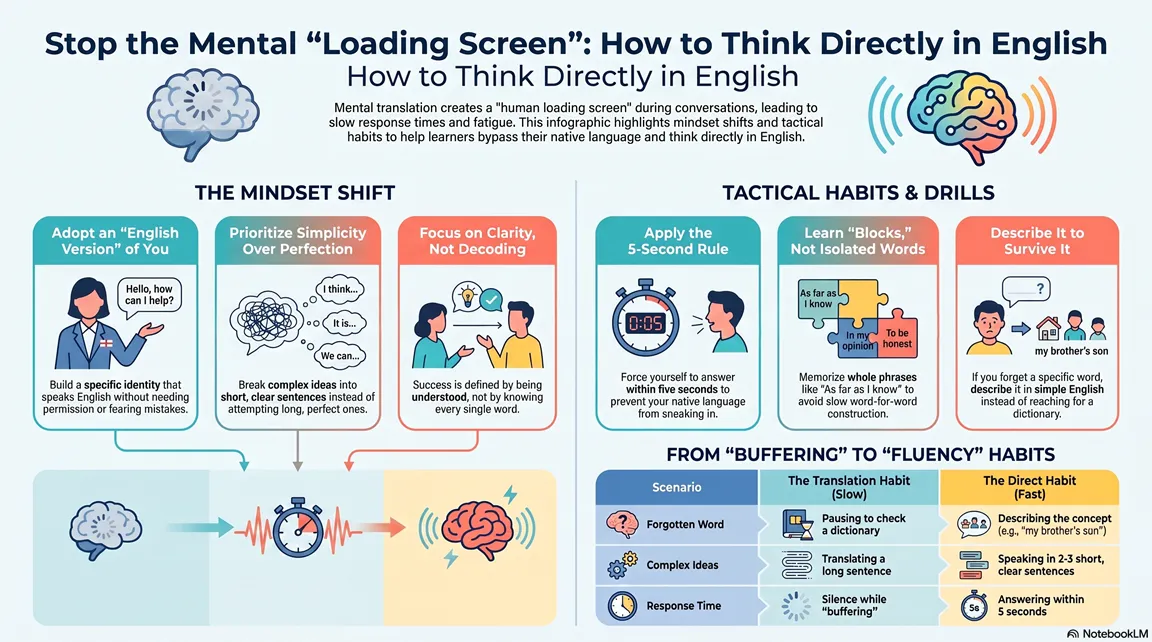
Do this instead: describe it. Forgot “nephew”? Say “my brother’s son.” Forgot “rainbow”? Say “the colors in the sky.” This isn’t cheating — native speakers do this all the time.
A few more small habits:
- New word, new picture — don’t think “gold” = the word in your language. Picture the shiny metal itself.
- If you must look something up, use an English-only learner’s dictionary (Merriam-Webster’s Learner’s Dictionary is free and simple). It explains the word in easy English, so your brain stays in English.
Say Short, Simple Sentences First
A big reason people freeze: they try to say something long and perfect, the way they’d say it in their own language. Then it falls apart halfway through.
Fix: break your idea into short pieces before you speak. Instead of trying to say “I want to go to the coast today because the weather looks great and I haven’t seen the sea in weeks,” just say: “I want to go to the coast today.” Then add: “The weather is nice.” Two short sentences beat one broken long one. Simple and clear always wins over perfect.
Learn Phrases, Not Just Words
Don’t build every sentence word by word — it’s slow, and it leads to mistakes. Instead, learn whole phrases as one block.
Word-by-word translation can also go wrong in funny ways. In French, looking up “full” (as in, “I’ve eaten enough”) can give you plein — but calling a person plein usually means they’re pregnant or drunk. Learning the whole phrase avoids this trap.
A few useful ones to start using right away:
- “As far as I know…”
- “To be honest…”
- “I’ll get back to you on that.”
- “The point is…”
- “Believe it or not…”
The 5-Second Rule
Translating loves silence. The pause where you search for the “perfect” word is exactly when your native language sneaks back in. So give yourself a rule: answer within 5 seconds, even if it’s not perfect. This trains your brain to go straight from ear to mouth.
A simple drill: shadowing.
- Listen to a short sentence from a native speaker.
- Repeat exactly what they said, at their speed.
- Right away, add your own follow-up sentence.
Example: someone says “The deadline moved to Friday.” You repeat it, then add: “Are we ready for it?” The speed is the whole point.
Stuck mid-sentence? Swap or describe: swap a hard word for an easy one (“profession” → “job”), or describe it, like in Section 4.
Create One English Zone in Your Day
Pick one place — your kitchen works well — where you only speak English. While you’re there, narrate what you’re doing:
- “I’m pouring water into the kettle.”
- “I’m opening the cupboard for a mug.”
- “I need to catch the bus. I hope I’m not late.”
For a harder challenge, play “Just a Minute”: pick any topic — your weekend, dogs, food — and talk for 60 seconds. Two rules: no long pauses, no repeating yourself. It’s uncomfortable, and that’s exactly why it works.
One more tip: keep study time and “just enjoying English” time separate. When you study, take your time and look things up. When you’re watching a show or listening to music, don’t stop for every word — just follow the story. Try watching without subtitles sometimes, even just for a few minutes. And don’t only listen — speaking and writing out loud is what really breaks the translation habit.
Practicing alone only gets you so far — at some point you need a real conversation partner who corrects you gently and keeps you talking. That’s exactly what Shadi’s lessons are for. [See available times →]
You Don’t Need to Be Perfect — Just Clear
The real shift happens when you stop “decoding” English and start just using it. That means getting comfortable not knowing every single word, and following the meaning anyway.
Translating got you this far. It helped you. Now the goal is simply to need it a little less every week — not to feel bad about needing it at all.
FAQ
Is it bad to translate in your head when learning English?
Not at the start — comparing English to your own language helps you learn the basic patterns fast. It becomes a problem later, when you already know the basics but still translate full sentences before speaking. That’s what causes the pauses.
How long does it take to stop translating in your head?
There’s no fixed number of weeks — it depends on how much you practice, not just time. Most people notice it happening slowly, one phrase at a time, not as one big moment.
Do people who speak two languages well still translate in their heads?
Usually not, in everyday conversation. With enough practice, the brain switches between languages directly. Even advanced speakers still pause to translate one tricky word sometimes — that’s completely normal.