

I’ve been teaching English online for over 7 years now . And if I had to guess the one thing almost every new student has in common, it’s not their level. It’s not their vocabulary. It’s this: they know more English than they let themselves use.
I had a student a while back — let’s call her Elif — who could write me a paragraph with almost no mistakes. Grammar, tenses, word choice, all solid. But the first time I asked her to just talk to me, no script, no prep, she went quiet for about ten seconds and then said, “Sorry, my English is bad.” It wasn’t. She just hadn’t given herself permission to be imperfect out loud.
| Common Fear | What You Might Think | Reality | Healthier Mindset |
|---|---|---|---|
| Making grammar mistakes | People will think my English is bad. | Most listeners care more about understanding than perfect grammar. | Focus on communicating your message clearly. |
| Mispronouncing words | Everyone will laugh at my accent. | Accents are normal, and pronunciation improves with practice. | Speak confidently and improve over time. |
| Forgetting vocabulary | I’ll sound stupid if I can’t remember a word. | Even native speakers forget words sometimes. | Use simpler words or explain your idea differently. |
| Speaking too slowly | I’m taking too long to answer. | Pausing to think is completely normal. | Take your time instead of rushing. |
| Being corrected | Corrections mean I’m failing. | Corrections help you improve faster. | Treat feedback as part of learning. |
| Comparing yourself to fluent speakers | I’ll never be that good. | Everyone starts as a beginner. | Compare yourself only to your past progress. |
| Avoiding conversations | It’s safer if I don’t speak. | Avoidance slows improvement. | Every conversation builds confidence. |
If that sounds like you, I want to walk you through why this happens, and then give you something more useful than “just relax” — actual things you can do this week.
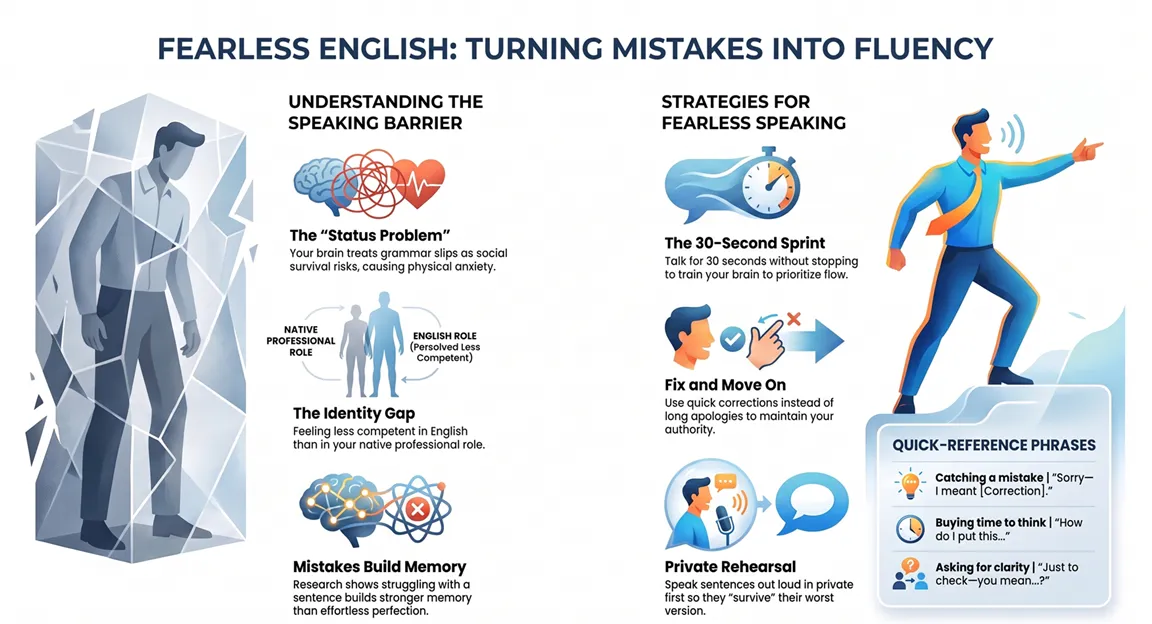
It’s Not a Language Problem. It’s a Status Problem.
Here’s the part most people never hear, and it changed how I teach once I understood it myself: your fear of sounding wrong in English has almost nothing to do with English.
For most of human history, sounding “less capable” in front of your group was genuinely risky. If people thought you were less sharp, you could lose your place in the group and a long time ago, that mattered for survival. Your brain never got the memo that this rule doesn’t apply to a slightly wrong verb tense on a video call with a client in another country. It still reacts like something is at stake.
That’s why a small grammar mistake can make your chest tighten the same way a real problem would. Your brain isn’t wrong to protect you, it’s just protecting you from the wrong thing. (Want to dive deeper? Check out the research on language anxiety and social pain.)
The Gap Between “Smart You” and “English You”
Here’s what makes this especially frustrating if you already have a career, run a business, or manage a team: in your own language, you’re good at your job. People take you seriously. Then you switch to English, and suddenly you sound — to yourself, at least — less competent than a teenager.
I call this the “two versions of you” problem in my lessons. There’s the version of you that negotiates contracts or manages a team in Turkish, Arabic, Spanish, whatever your first language is. And there’s the English version, who sometimes can’t remember the past tense of “buy.” That gap feels bad. It’s not really about vocabulary — it’s about identity.
And here’s something worth knowing: psychologists call this the “negativity bias“, your brain remembers your one bad moment far more strongly than your fifty good ones. One awkward pause in a meeting sticks in your memory. Fifty smooth conversations don’t. This isn’t a fair way to measure your own progress, but it’s how attention works, and once you know that, you can stop trusting that inner voice quite so much.
I’ll add one more thing I tell every student at some point: native speakers mess up constantly. I’ve heard native English speakers mix up “who” and “whom,” forget which preposition goes where, lose their sentence halfway through and just restart (see Levelt’s research). Nobody in the room thinks less of them. The standard you’re holding yourself to isn’t a real standard — it’s one you invented.
Mistakes Are Actually Doing the Learning For You
This next part isn’t just something I tell students to make them feel better — it holds up in research on how people actually learn a second language. When you try to say something, get it slightly wrong, and then get corrected, that struggle seems to build stronger memory than saying it correctly the first time with no effort at all.
In plain terms: the mistake isn’t standing between you and fluency. It’s part of how fluency gets built. If you avoid ever risking a wrong sentence, you also avoid the correction that would have helped you fix it. I’ve watched this play out with perfectionist students for years — the ones most afraid to make mistakes often improve the slowest, not because they’re less capable, but because they give themselves fewer chances to actually be corrected.
There’s a second piece worth mentioning. Learners who believe ability grows with practice tend to pay closer attention to their mistakes and improve faster than learners who believe ability is mostly fixed or natural talent(see Dweck research). I see this constantly in my own lessons — two students at the same level, same corrections, and the one who treats a mistake as useful information instead of a bad grade almost always progresses faster.
Six Things That Actually Help (Not Just “Practice More”)
Understanding why the fear exists helps, but it won’t make it disappear on its own. These are things I actually give my students to do, not just general advice.
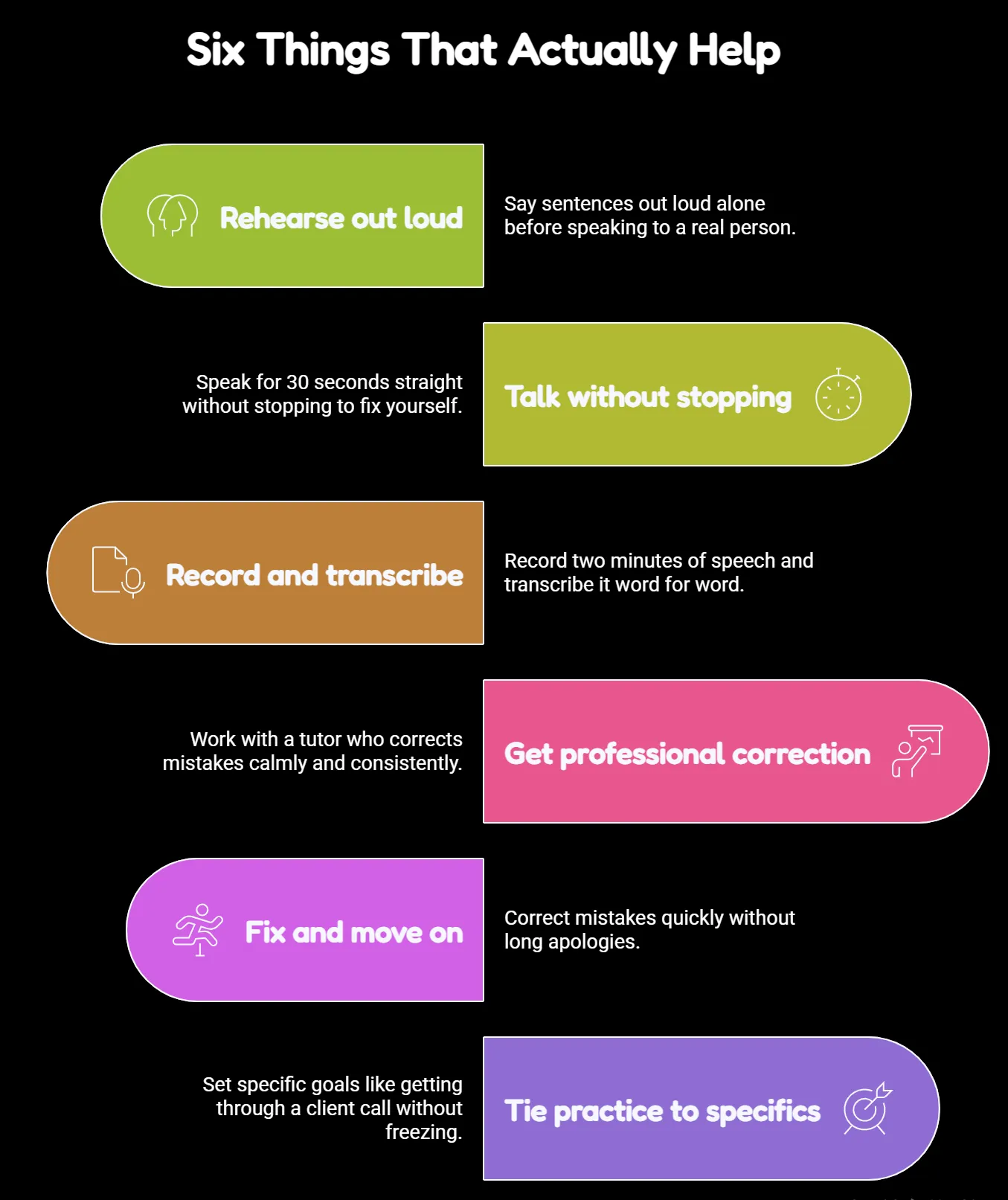
- Rehearse out loud before it counts. Before a call, an interview, or even a lesson where you know a certain topic is coming up, say it out loud first — alone, in your kitchen, in the shower, wherever. Let the sentence fail in private first. By the time you say it to a real person, it’s already survived its worst version.
- Talk for 30 seconds without stopping. Pick something simple — your weekend, your commute, a show you’re watching — and talk for 30 seconds straight, no stopping to fix yourself. The goal isn’t correctness here. The goal is training your brain that stopping is worse than a mistake.
- Record yourself, then write down exactly what you said. This one surprises students every time. Talk for two minutes, then transcribe it word for word. Suddenly “I sound bad” turns into “oh, I keep dropping articles before plural nouns” — which is a fixable, specific problem instead of a vague feeling of failure.
- Get corrected by someone whose actual job is to correct you calmly. This is honestly one of the biggest reasons working with a tutor helps more than practicing only with coworkers or friends — a tutor corrects you the same calm way every time, so your brain stops associating mistakes with embarrassment and starts associating them with useful information.
- Fix it and move on — don’t apologize for three sentences. When you catch your own mistake mid-sentence, a quick “sorry, I meant—” and continuing is what confident speakers actually do. Long apologies draw more attention to the mistake than the mistake itself ever would.
- Tie your practice to something specific. “I want to improve my English” is easy to give up on. “I want to get through my next call with a client without freezing” is not. Give your brain an actual reason to push past the fear.
Practice Has to Match Where You’ll Actually Use It
If your fear shows up mainly when you’re talking to a new client, meeting new people, or speaking up in a group — practicing alone with an app won’t fully fix that, because the fear is tied to the situation, not just the language.
This is the part of teaching I actually enjoy most: building a lesson around the real conversation someone is dreading. Introducing yourself to a new international client. Speaking up in a meeting without over-explaining. Ordering food and actually understanding the reply instead of just nodding. When we rehearse the specific moment that scares you, the fear has somewhere real to go — instead of just sitting there as background anxiety.
Phrases Worth Keeping in Your Back Pocket
I give these to almost every student at some point, because having something ready beats improvising under pressure.
| Situation | What you can say |
|---|---|
| Catching your own mistake | “Sorry — I meant last week.” / “Let me say that again.” |
| Buying a second to think | “What I mean is…” / “How do I put this…” |
| Disagreeing without being rude | “I see it a bit differently — for me…” / “Can I share another way to look at it?” |
| Introducing yourself | “I work in [field] — mainly with…” / “Good to meet you, what brings you here?” |
| Asking someone to repeat something | “Sorry, could you say that again?” / “Just to check — you mean…?” |
| Explaining something simply | “The main point is…” / “Basically, what I mean is…” |
A Few Honest Questions Students Ask Me
Does being scared to speak mean my English isn’t good enough? No — I’ve had B2 and even C1 students freeze up just as much as beginners. This fear tracks how risky a moment feels, not how much English you actually know.
Do mistakes really help me learn faster, or is that just something teachers say? It holds up in practice, in my experience and in the research — but only if the mistake gets corrected and you try again. A mistake nobody ever points out to you doesn’t teach you much.
What can I do right before an important call to calm down? Say the actual sentences you expect to need, out loud, beforehand. Not the whole speech — just the two or three lines you’re most nervous about.
Should I correct myself out loud when I notice a mistake? Yes. Quick and calm beats a long apology every time. The apology is what people remember, not the small grammar slip.
The Bottom Line
Your fear of making mistakes in English isn’t proof that your English is bad. It’s an old part of your brain treating a language slip like a social risk it hasn’t updated for. That understanding won’t make the fear vanish tomorrow, but it does make it a lot easier to keep talking anyway.
Every mistake you make out loud is quietly doing its job — building the fluency, not blocking it.
If you want to actually practice this instead of just reading about it, that’s what our lessons are for. Real conversations, real mistakes, real feedback — no judgment, just progress.
Book a lesson with me, Shadi, and let’s work on the exact conversations that make you nervous — until they don’t anymore.